


 English
When it comes to reliable shelter in the outdoors, tarps for campers remain the single most versatile piece of kit you can carry. A properly selected PVC tarpaulin cover weighs a fraction of a tent, sets up in minutes, and can handle conditions that would leave a cheap polyester shelter leaking by midnight. This guide cuts straight to what matters: material grades, sizing logic, rigging methods, weather ratings, and how to pick between PVC tarpaulin cover options and lighter alternatives for different trip types.
Why Campers Choose PVC Tarpaulin Cover Over Other Materials
Not all tarps are built alike. The market splits roughly into three fabric families: woven polyethylene (poly tarp), ripstop nylon or polyester, and PVC tarpaulin cover. For camping applications that involve extended rain, coastal winds, or heavy-use communal shelters, PVC dominates on every functional metric that matters.
Waterproofing That Lasts
A quality PVC tarpaulin cover carries a hydrostatic head rating between 1,500 mm and 3,000 mm. Standard polyethylene tarps sold at hardware stores typically fall between 500 mm and 800 mm. In practical terms, a sustained downpour at 25 mm/hr will penetrate a cheap poly tarp within an hour. It won't penetrate a properly rated PVC tarp at all. The PVC laminate bonds directly to the base fabric rather than relying on a topcoat that wears away, which is why ratings stay consistent across the product's lifespan.
UV Stability Over Seasons
Standard poly tarps degrade visibly within 18–24 months of outdoor use in full sun. The UV stabilizers added during the extrusion process break down faster than advertised. PVC tarpaulin cover formulations incorporate carbon black or titanium dioxide UV blockers within the PVC compound itself, not as a surface layer. Independent testing by the Outdoor Industry Association has shown that properly compounded PVC retains over 85% of its tensile strength after 2,000 hours of UV exposure, compared to roughly 50% for untreated poly tarp at the same exposure.
Tear Resistance Under Load
Camping tarps take point loads at grommet positions, especially when wind flaps them against trees or poles. PVC tarpaulin cover construction uses reinforced mesh scrim between PVC layers, with grommet spacing standardized at every 90–100 cm on quality products. The scrim prevents tear propagation that would start a rip running across a poly tarp in a single gust. For canopy or communal dining shelter use, this structural integrity is the defining factor.
Mold and Mildew Resistance
Stored wet, a nylon or polyester tarp will carry mold smell by the next season. PVC tarpaulin cover repels biological growth because the smooth laminate surface offers no capillary channels for moisture. Most quality PVC tarp compounds also include fungicidal additives in the formulation. For campers who store tarps in damp garages or vehicle trunks between trips, this is not a minor point — it is the difference between pulling out a clean shelter and throwing away what should have been a decade-long investment.
PVC Tarpaulin Cover Weight Grades Explained for Campers
PVC tarpaulin cover products are sold by GSM (grams per square meter). Selecting the wrong weight grade is the most common purchasing mistake. Lighter weights save pack weight; heavier weights deliver structural durability. The table below maps GSM ranges to real-world camping applications.
| GSM Range | Thickness (approx.) | Best Camping Use | Hydrostatic Head | Weight per m² |
|---|---|---|---|---|
| 250–350 GSM | 0.25–0.35 mm | Lightweight backpacking, summer rain cover | 1,000–1,500 mm | 250–350 g |
| 400–500 GSM | 0.40–0.50 mm | Car camping, base camp canopy, kitchen shelter | 1,500–2,000 mm | 400–500 g |
| 550–650 GSM | 0.55–0.65 mm | Festival camping, group shelter, coastal exposure | 2,000–2,500 mm | 550–650 g |
| 700–900 GSM | 0.70–0.90 mm | Semi-permanent camp structures, truck bed covers | 2,500–3,000+ mm | 700–900 g |
For most tarps-for-campers applications, the 400–500 GSM range delivers the best balance. A 4 m × 5 m tarp at 450 GSM weighs approximately 9 kg — manageable for car camping, robust enough to serve as a reliable camp kitchen or sleeping shelter through multi-day rain events.

Sizing Tarps for Campers: Getting the Dimensions Right
One of the most persistent mistakes in tarp selection is undersizing. The finished waterproof area of any tarp setup is always smaller than the tarp itself, because pitch angle and guy-line geometry reduce the effective footprint. A tarp rigged at a 45-degree A-frame angle loses approximately 30–40% of its linear dimension on each side as usable headroom. Here's how to size correctly for common camping scenarios.
Covers one sleeping mat with enough pitch to shed rain without blowback. A PVC tarpaulin cover at this dimension weighs 2.8–3.4 kg at 450 GSM. Ultralight alternatives in silnylon exist at under 500 g but sacrifice durability significantly.
Covers two sleeping areas side-by-side under an A-frame or lean-to with enough overhang to prevent sidewall splash-back during heavy rain. This size also works as a communal cooking canopy in dry conditions.
A 4 × 6 m PVC tarpaulin cover at 500 GSM provides approximately 18–20 m² of covered ground area under a standard ridge-line pitch. That accommodates a camp table, four chairs, and a cook station with room to move.
Commercial PVC tarpaulin cover suppliers offer custom-cut dimensions with heat-welded seams and reinforced perimeter hems. For groups of 8–12 people sharing a communal space, custom sizing avoids the cascading failure points of overlapping multiple standard tarps.
Critical Note on Labelled vs. Actual Dimensions
Many budget PVC tarpaulin cover products sold online list nominal dimensions that include the hem. A tarp labelled 3 m × 4 m may have a waterproof panel of only 2.7 m × 3.7 m once the reinforced hem and folded grommet zone are measured. Quality manufacturers specify both the overall dimension and the waterproof panel dimension separately. When comparing products, always ask for or verify the waterproof panel measurement specifically.
Rigging Tarps for Campers: Configurations That Actually Work
The pitch geometry of your tarp determines everything: rain runoff, wind resistance, interior space, and condensation management. Below are the configurations used most consistently by experienced campers, with their practical tradeoffs.
A-Frame Ridge Line
The most weather-stable pitch. Run a horizontal line between two trees or poles at head height, drape the PVC tarpaulin cover over it, and stake out each side at a 45-degree angle. This configuration sheds water equally on both sides and survives wind speeds up to 50 km/h when properly staked with storm pegs. It sacrifices interior volume — ceiling height at center approaches ground level on the sides — but maximizes structural integrity in severe weather.
Lean-To (Angled Canopy)
One edge elevated at 2 m, the opposite edge staked near the ground. This opens the front of the shelter completely while protecting the interior from rain driven from behind. For a communal camp kitchen or outdoor cooking area, this is the standard choice. A 4 × 5 m PVC tarpaulin cover in lean-to configuration provides approximately 12–14 m² of usable covered space at walking height. The tradeoff: exposed to wind from the open face. Orient the open face downwind of the prevailing wind direction.
Diamond Pitch (Single Point High)
Orient the tarp on the diagonal, raise the center point on a single pole or branch, and stake the four corners out as low side panels. This creates a pyramidal shelter with excellent central height and 360-degree rain protection. Best suited for solo use or pairs where you need to move around inside. Not ideal for PVC tarpaulin cover products above 600 GSM, since the weight of the tarp pulls on the single high point and can bend lightweight poles.
Flat Canopy with Corner Poles
All four corners elevated equally on adjustable poles, with a slight center dip to prevent water pooling. This is the default configuration for car camp communal shelters and festival setups. The PVC tarpaulin cover functions as a freestanding flat roof over a seating or dining area. Wind resistance is lower than an A-frame or lean-to, so guy lines from the corner grommets to additional stakes are essential in anything above light breeze. Pole height should be set to allow rain runoff to clear the perimeter rather than drip onto occupants at table height.
Grommet Load Limits and Failure Points
Grommets on most PVC tarpaulin cover products are rated for sustained loads of 80–150 kg depending on grommet diameter and backing plate design. In storm conditions, a tarp catching wind load can develop pull forces well beyond that. The failure point is almost never the grommet itself — it is the junction between the grommet backing and the tarp material. To distribute load, thread guy lines through the grommet and also tie a timber hitch around the balled-up corner of the tarp itself. This effectively moves the load to the reinforced hem rather than the grommet alone, and reduces failure risk significantly.
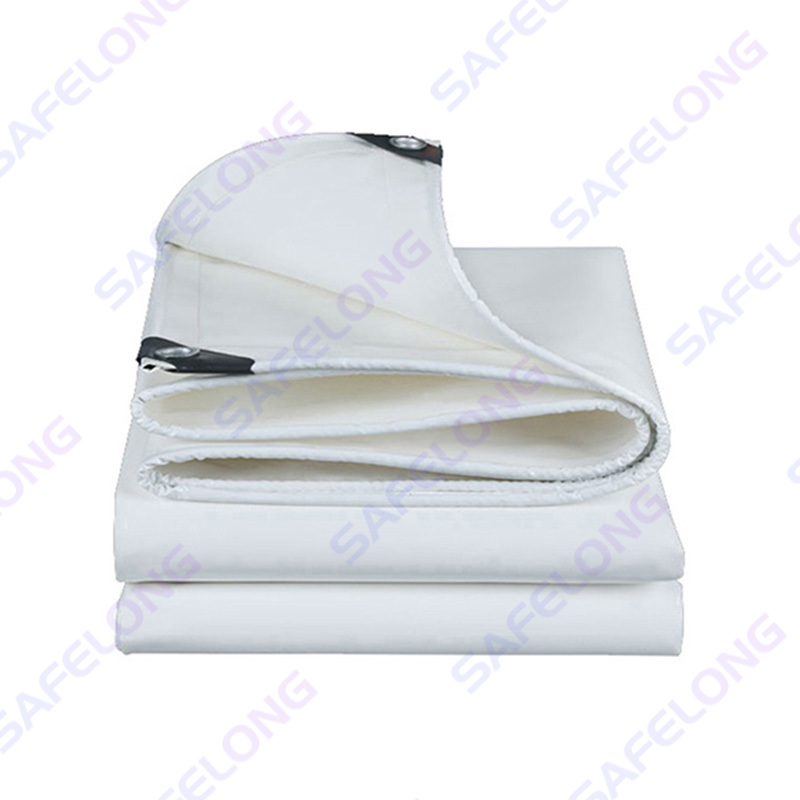
Tarps for Campers: PVC vs. Silnylon vs. Polyethylene Compared
The tarp market for campers spans several materials, and each has scenarios where it outperforms the others. The comparison below covers the variables that matter most for actual field use rather than catalogue marketing language.
| Property | PVC Tarpaulin Cover | Silnylon/SilPoly | Woven Polyethylene |
|---|---|---|---|
| Weight (per m²) | 350–900 g | 40–80 g | 80–200 g |
| Hydrostatic head | 1,500–3,000+ mm | 1,200–3,000 mm | 500–1,000 mm |
| UV resistance | Excellent (5–10 yr) | Good (3–6 yr) | Poor (1–2 yr) |
| Packability | Bulky, vehicle carry | Compresses small | Moderate |
| Tear resistance | Excellent | Good (ripstop) | Low |
| Mold resistance | Excellent | Moderate | Poor |
| Cold weather flex | Stiffens below -10°C | Stays flexible | Brittles below -15°C |
| Repairability | PVC patch, heat weld | Tenacious Tape | Duct tape (short term) |
| Price range (3×4 m) | $40–$150 | $80–$300 | $10–$35 |
The verdict: PVC tarpaulin cover wins decisively for car camping, base camping, group shelters, and any situation where longevity and rain performance take priority over pack weight. Silnylon wins for ultralight backpacking where every gram counts. Polyethylene tarps belong in emergency kits or very occasional light use only.
Weather Performance: What Tarps for Campers Really Need to Handle
Camping weather is not consistent. A summer weekend can involve calm conditions that turn into a 60 km/h gusting storm overnight. Understanding what weather loads actually mean for your PVC tarpaulin cover is the difference between confidently sleeping through rain and lying awake watching for leaks.
Rain: Intensity Categories and What They Mean
Meteorological rain intensity is measured in mm/hr. Light rain is classified as below 2.5 mm/hr. Moderate rain falls between 2.5 and 7.5 mm/hr. Heavy rain exceeds 7.5 mm/hr, and very heavy or torrential rain exceeds 50 mm/hr in extreme events. (Source: World Meteorological Organization rain intensity scale.)
A PVC tarpaulin cover rated at 2,000 mm hydrostatic head will handle sustained heavy rain indefinitely when pitched correctly. The risk under extreme tropical downpours is not penetration — it is ponding on a flat-pitched tarp. Water pooling in a low point at 50 mm/hr accumulates fast enough to stress the tarp seam and grommet positions. Always ensure at least a 15-degree pitch angle to force runoff.
Wind: Load Calculation and Staking Strategy
Wind pressure on a tarp increases with the square of wind speed. A 40 km/h wind exerts roughly 25 kg of force per square meter of tarp surface area at a perpendicular angle. A 4 × 5 m flat canopy tarp in a 40 km/h crosswind is experiencing approximately 500 kg of total lateral load. This is why flat canopy configurations fail in wind — there is no mechanism to deflect the load. Peaked or angled configurations redirect wind pressure rather than absorbing it.
For storm conditions, use steel shepherd's hook stakes (not the standard plastic peg), space guy lines no more than every 1 m along the edge, and bury the windward edge stakes at a 45-degree angle leaning away from the tarp. This stake geometry distributes pull force along the stake's length rather than the tip alone, and increases pull-out resistance by a factor of 2–3 compared to vertical staking.
Cold and Snow: Load Bearing on PVC Tarpaulin Cover
Snow accumulation on a tarp creates compressive load that a flat pitch cannot support for long. Fresh snow weighs approximately 50–100 kg per cubic meter; wet spring snow can reach 200–400 kg per cubic meter. A 4 × 5 m flat tarp with 20 cm of wet snow accumulated is supporting over 400–800 kg of load — well beyond the structural capacity of any standard PVC tarpaulin cover. In snow camping, always use steep A-frame or peaked pitches to allow snow to slide off, and include a center ridge pole to add support if the tarp must be flat-pitched.
Cold also affects PVC material behavior. Most standard PVC tarpaulin cover products become noticeably stiffer below 0°C and can crack at fold lines if forced below -10°C. For winter camping, look for cold-weather-grade PVC with plasticizer formulations that maintain flexibility to -20°C or lower. These products are more expensive but essential for any camping below freezing.
Practical Setup Tips for Tarps for Campers That Most Guides Skip
Published tarp guides generally cover the basics. The following points address the setup failures that actually happen in the field and are rarely discussed in product descriptions or beginner guides.
- Pre-tension your guy lines before the storm arrives. PVC tarpaulin cover fabrics stretch slightly under initial loading. Set up in dry conditions, tension everything, then loosen and re-tension after the tarp has settled for an hour. A tarp tensioned cold will go slack and sag when rain weight adds.
- Never tie directly to a single grommet for a main load-bearing point. Thread the guy line through the grommet, then loop back through a timber hitch on the folded corner. This creates two contact points and prevents the classic single-point tear failure.
- Orient your tarp lengthwise to the prevailing wind direction. A ridge-line A-frame cuts wind most effectively when the long axis runs parallel to wind direction, with the peaked ridge acting as a splitter rather than a wall.
- Leave at least 30 cm overhang beyond your sleeping area on the rain side. Rain falling at an angle in wind will penetrate 40–60 cm inside the edge of a vertical tarp wall. Increase overhang to 60 cm minimum in exposed locations.
- Use 6 mm polypropylene or 4 mm Dyneema for guy lines, not bungee. Bungee stretches so much under wind load that it allows the tarp to oscillate, which fatigue-stresses grommets within hours. Static line with a taut-line hitch or line tensioner maintains consistent geometry.
- When using a PVC tarpaulin cover over a tent as a rain fly, maintain at least 15 cm air gap. Contact between tarp and tent outer creates a pathway for moisture through capillary action. The air gap also traps insulation and prevents condensation transfer.
- Mark your ridge line attachment points with electrical tape before the trip. Finding the center point and quarter points in the dark during a rain event costs time and involves handling the tarp incorrectly. Pre-marking saves setup errors.
- Store PVC tarpaulin cover loosely rolled, not tightly folded. Repeated fold creases at the same position weaken the PVC laminate over time. Rolling distributes stress evenly and extends usable life significantly.
Cleaning and Maintaining Your PVC Tarpaulin Cover for Years of Use
A PVC tarpaulin cover maintained correctly will outlast its owner's camping career. Neglected, it will fail within three to five years. The maintenance requirements are minimal but specific.
Shake off loose debris. If the tarp is damp, unroll it flat or hang it stretched in the shade until dry. Never store PVC tarpaulin cover products wet. Even PVC resists mold growth, but the grommet metal and any bonded webbing can corrode when sealed with moisture inside a stuff sack. Air-dry completely before rolling for storage.
Wash with warm water and a mild pH-neutral soap. Avoid bleach, petroleum solvents, and abrasive scrubbers — all of these attack the plasticizers in PVC that keep it flexible. A soft-bristle brush removes bird droppings, tree sap, and ground-in soil without surface damage. Rinse thoroughly and air-dry. Do not machine-wash or tumble-dry PVC tarpaulin cover material.
Check each grommet for corrosion, looseness, or micro-cracks in the surrounding PVC. Grommets that spin freely in their hole have lost their crimp — replace the tarp or have a new grommet pressed by a tarpaulin supplier. Most grommet presses cost under $30 and work with standard hole sizes. Replacing a grommet takes five minutes and adds another season to a tarp's life.
Small tears in PVC tarpaulin cover material do not stay small. Wind load at a 2 cm tear will extend it to 20 cm in a single storm. Carry PVC repair tape (solvent-based adhesive, not pressure-sensitive only) on every trip. For permanent repairs, use a PVC patch bonded with PVC contact cement or a heat gun. The repair should overlap the tear by at least 5 cm on every side for reliable adhesion.

Buyer Checklist: What to Verify Before Purchasing Tarps for Campers
The online market for tarps for campers includes products ranging from excellent to genuinely hazardous in a storm. The following checklist narrows down what you actually need to confirm before committing to a purchase.
- Confirm the GSM rating — not just the description of "heavy duty." Any supplier who cannot provide an actual GSM figure is selling on marketing language alone.
- Verify the hydrostatic head test result in millimeters. A PVC tarpaulin cover without a hydrostatic head specification has not been tested to a standard — or the results were not acceptable enough to publish.
- Measure the actual waterproof panel, not the overall listed dimension. The hem zone adds 10–15 cm per side in most products.
- Count and check grommet spacing. Grommets should appear every 90–100 cm around the perimeter minimum. Sparse grommet placement (every 150 cm or wider) creates concentrated load points that fail under storm conditions.
- Check grommet material. Stainless steel or solid brass are preferable. Painted zinc die-cast grommets corrode in coastal environments within two seasons.
- Inspect hem construction. A reinforced perimeter hem of at least 5 cm width with a continuous load-bearing webbing strip indicates quality construction. A simple folded-and-stitched hem is a failure point under load.
- Confirm cold-temperature rating if camping below 0°C. Standard PVC tarpaulin cover products will stiffen significantly; cold-grade formulations maintain flexibility to -20°C or lower.
- Ask about the UV stabilizer type and projected lifespan for your climate. Suppliers that cannot answer this question are reselling unspecified imports.
Beyond Rain Cover: Other Uses of PVC Tarpaulin Cover in a Camp Setting
A quality PVC tarpaulin cover earns its weight by serving multiple roles across a camping trip. Experienced campers carry one or two large tarps and get more utility from them than from an equivalent weight of single-purpose gear.
Under a tent or bivy, a PVC tarpaulin cover cut slightly smaller than the tent footprint prevents ground moisture from wicking up through the tent floor. The PVC's non-permeable surface also insulates against ground cold better than thin PE sheets.
Hung vertically between poles or trees on the windward side of a camp, a PVC tarpaulin cover reduces wind chill significantly. A sustained 30 km/h wind blocked by a tarp wall reduces perceived temperature by an equivalent of 4–6°C for anyone sheltered on the lee side.
Wrapped around firewood, generator, cooler, or bicycle, a PVC tarpaulin cover protects gear stored outside from overnight rain without requiring a dedicated cover for each item. The UV resistance means extended outdoor storage does not degrade the tarp even when left in place for weeks.
Hung as a privacy screen around a camp shower or solar shower bag, a PVC tarpaulin cover provides both privacy and wind protection. The waterproof surface handles splash without absorbing moisture, making it easy to shake dry and pack immediately after use.
A full-size PVC tarpaulin cover rolled around two poles forms a functional stretcher rated for an average adult. This is a non-trivial consideration for remote camping where evacuation of an injured person may need to happen before outside assistance arrives.
A PVC tarpaulin cover thrown over an open truck bed or trailer keeps camping gear dry during transport without requiring a tonneau cover. The UV-stable surface handles highway-speed wind and sun exposure without degradation, making it a permanent part of the camping transport kit.
Matching the Right Tarp to the Right Camping Scenario
Not every camping situation calls for the same tarp specification. The following recommendations are based on scenario analysis rather than generic advice.
Weekend Car Camping in a Forested Area
Choose a 4 × 5 m PVC tarpaulin cover at 450 GSM, green or tan coloring. The forest cover reduces UV load, so UV stabilization is less critical. Primary function is rain shelter for cooking and socializing. Set up in lean-to or flat canopy configuration. Total kit weight around 9–10 kg including poles and stakes — acceptable for vehicle carry.
Coastal and Beach Camping
UV exposure at coastal sites is 20–30% higher than inland forests due to sand reflectance and absence of tree shade. Wind load is consistently higher and salt air accelerates metal corrosion. Select a 550+ GSM PVC tarpaulin cover with stainless steel grommets and strong UV inhibition rating. A-frame pitch is the only viable configuration in sustained coastal winds above 30 km/h. Replace any zinc grommet products immediately for coastal use.
Multi-Day Backpacking with Vehicle Drop-off
PVC tarpaulin cover weight becomes a limiting factor here. For 3–5 day packs where total carry weight matters, a 2.5 × 3 m tarp at 300 GSM (weight approximately 2.25 kg) is the lightest PVC option. Consider whether the silnylon alternative at 350 g makes more sense for the trip profile. If the route involves river crossings, exposed ridges, or known heavy rain probability, the extra waterproofing performance of PVC justifies the weight penalty.
Festival and Group Camping
Festival sites involve dense crowds, erratic pedestrian traffic near guy lines, and sustained multi-day exposure. A 6 × 8 m PVC tarpaulin cover at 600 GSM configured as a flat communal canopy on 2 m poles covers 12–16 people seated at tables. Use high-visibility guy lines (orange or yellow) to prevent tripping incidents. Stake all guy lines to buried dead-man anchors if the site does not allow stakes — PVC tarpaulin cover panels at this size will become structural sails in any meaningful wind if not fully anchored.
 이전
이전


